9 minute read
From Evangelical Roots to Ostara Discovery
Opening Reflection
This story is about moving from an Evangelical upbringing toward Ostara discovery in a way that felt quiet, uneven, and real. It holds spring equinox reflection, faith transition tenderness, and the strange softness of finding everyday meaning again.
I was not looking for a dramatic rebellion. I was looking for a gentler way to belong to the season.
The Spring I Did Not Know How to Name
I grew up in a world where spring already had a script. The colors were chosen for me. The songs were chosen for me. Even the wonder came pre-labeled, handed over in tidy pieces with the meaning attached so tightly there was no room left to touch it with my own hands.
Back then, I did not think of that as strange. Children usually do not notice the walls of a room until they lean against them. I just knew that certain symbols were safe, certain questions were risky, and beauty was easiest to hold when someone else told you what it meant first.
So when the first warm days of the year arrived, I felt them through borrowed language. Budding branches, wet dirt, pale sky, birds making a racket before breakfast — all of it came filtered through an old framework. It was lovely, but it was managed. Explained. Settled before it could fully stir me.
Years later, after I had already started loosening my grip on that version of certainty, spring began to feel stranger. Not in a scary way. In a haunted way. Like something old was calling me by a name I almost recognized. I would notice the thaw and feel an ache I could not quite sort. Not grief exactly. Not longing exactly. Just a deep internal tug, as if the season was trying to speak under all the inherited noise.
That was when I started noticing how much of my life had been spent translating my own instincts into approved terms. I was always checking the map before trusting the landscape. Even simple wonder had to pass inspection.
There is a particular exhaustion that comes from that. Not the loud kind. The quiet kind. The kind that settles into your shoulders and makes your inner life feel over-supervised.
I think that is partly why posts like discovering magic in the mundane, right here now today started landing differently for me. I did not need spring to become a grand mystical event. I just needed permission to notice it without immediately placing it inside someone else's frame.
And once that permission appeared, even in a tiny way, the whole season changed texture. It became less like a lesson and more like a signal.
The Old Language Still in My Mouth
Faith transition is strange because your thoughts can move faster than your body. Intellectually, I had already made distance. I knew I was allowed to question things. I knew I did not need to keep every belief that shaped my childhood. But the nervous system is not a light switch, and neither is symbolism.
Sometimes I would feel drawn to something soft, seasonal, or symbolic and still catch an old flinch underneath it. A small internal recoil. Not because I believed I was doing something wrong, exactly, but because curiosity itself had once been treated like a threshold you could cross by accident and regret later.
That old language stayed in my mouth for a long time. Even after I stopped believing certain things, I still reacted to them. I still knew how fear sounded when it dressed itself up as virtue. I still knew how quickly wonder could be recast as danger.
There was grief in that. Not just grief for what I lost, but grief for how suspicious I had learned to become of my own openness.
What helped was not forcing myself into a new identity as quickly as possible. It was learning to sit inside ambiguity without treating it like failure. That is a skill I had to build slowly, and using different perspectives: a gentle, practical guide fits that season of my life more than I can explain. Sometimes I did not need a final answer. I just needed another angle soft enough for my mind to stop bracing.
I also found myself circling old fears through gentler doors. Reading What's the Deal with the Rapture? A Gentle Inquiry did not feel like rebellion for rebellion's sake. It felt like touching a scar with clean hands and finally admitting it was still tender.
That mattered. Because I did not want to become cruel in order to become free. I did not want to mock the people who raised me, or flatten their beliefs into caricature just so I could feel distant from them. My life would have been simpler if anger alone had solved it. But it did not. What I needed was subtler than that.
I needed room to hear myself.
Not the performance version. Not the impressive version. The quieter voice underneath. The one that responded to light through bare branches, to muddy paths, to the hum of return, and did not want to argue its case before being allowed to feel it.
Finding Ostara Without Needing to Win
The first time I really let myself look at Ostara, I almost embarrassed myself with how cautious I was. I approached it like a person trying not to spook a small animal. Too fast and it would run. Too intense and I would start mistrusting my own interest.
Part of that caution was practical. I did not want to replace one rigid certainty with another. I was not looking for a shinier system to obey. I was looking for a way to relate to seasonality, symbolism, and renewal that did not demand total surrender of my discernment.
Ostara felt different from what I had known because it did not arrive like a command. It arrived like an opening. A seasonal threshold. A way of noticing balance, return, and beginning again without pretending everything was instantly transformed.
That softness was almost suspicious to me at first. I had been trained to think truth should feel sharp, final, and absolute. But Ostara, at least as I encountered it, felt more like being invited to sit by a window and pay attention.
I kept one grounded reference nearby while I explored: the Encyclopaedia Britannica overview of the spring equinox. I liked having something plain and factual in reach. Not because I needed permission from an encyclopedia, but because it helped me stay rooted while my inner world wandered into newer rooms.
The deeper shift was emotional. I stopped treating every spiritual curiosity like a courtroom battle. I did not need to prove Ostara was superior. I did not need to renounce every former association in some dramatic speech. I just needed to notice what happened in me when I let the season mean more than one thing.
And what happened was simple. I softened.
The world itself started to feel more available. I opened the curtains earlier. I noticed puddles reflecting clean light. I let myself feel the fragile excitement of buds before they were impressive. That season of my life had a lot in common with returning to quiet projects with gentle hands. I was not inventing a brand-new self. I was reapproaching a part of myself I had kept under supervision for a very long time.
Even reflective tools started making more sense to me under that softer lens. Tarot as a Secular Tool: Pattern-Reading for Everyday Decisions echoed something I was learning in real time: symbols did not need to control me to be meaningful. They could be companions. Prompts. Mirrors. Seasonal characters that helped me notice what was already stirring.
That was the gift. Not certainty. Not correctness. Just a less armored way to be alive in spring.
A Table by the Window
My first real Ostara moment was small enough that another person might have missed it entirely. No dramatic ritual tools. No perfect altar. No scene designed to look ancient or impressive.
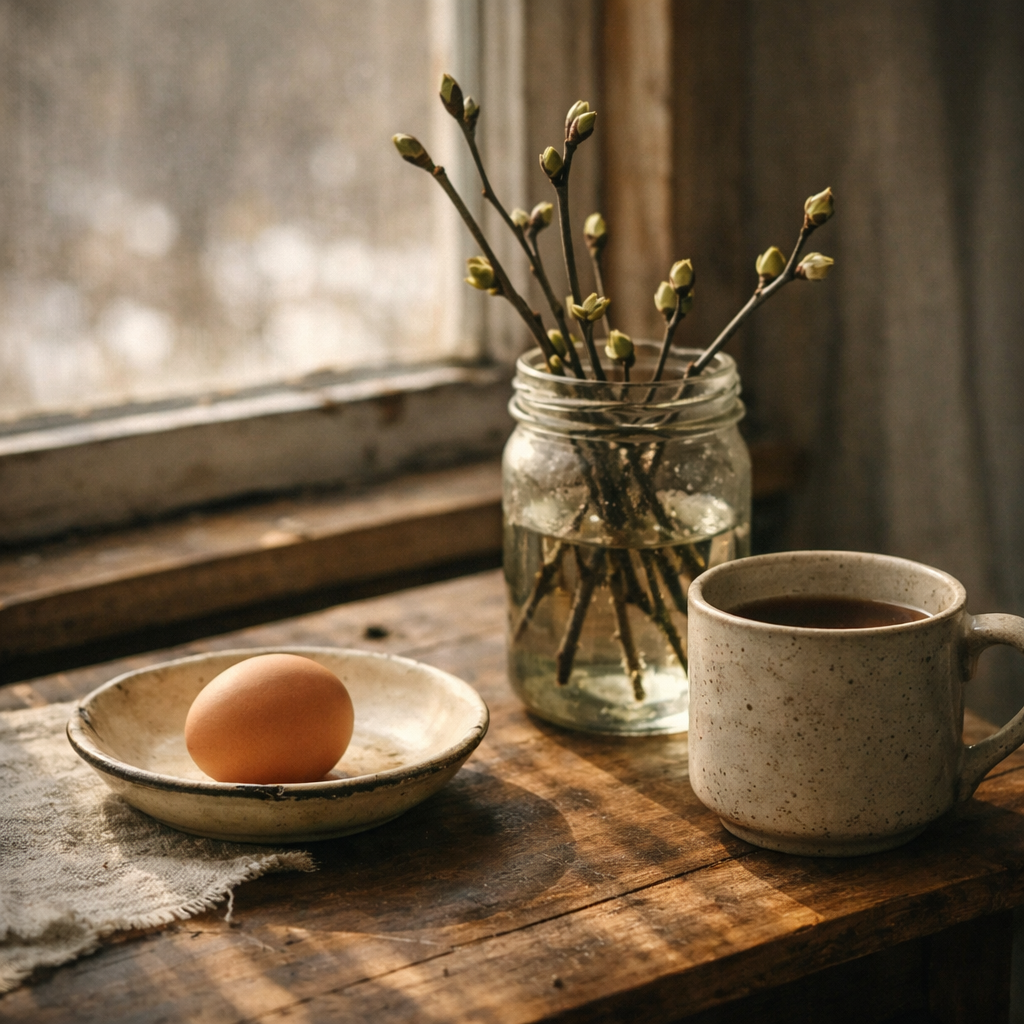
Just a table by the window.
I set down a thrifted dish, an egg, a mug, and a few clipped branches that looked like they were still deciding whether to open. Morning light fell across the surface in that particular shy way early spring light does, and the whole arrangement felt both ordinary and a little charged.
I remember laughing at myself a little. Not in a mean way. In an affectionate way. Like: oh, so this matters to you. Look at that.
There is something healing about sincerity that does not need to become spectacle. That tiny table held exactly that. It was not there to prove anything. It was there to let me practice attention.
And attention, I was learning, is its own kind of threshold.
I stood there holding my tea and felt something in me drop into place by half an inch. It was not ecstasy. It was not revelation. It was quieter than that. More trustworthy. I felt present in my own life for a moment without needing to justify it.
That presence reminded me of tiny gratitude rituals, though I was barely ready to call anything a ritual yet. The old language still made me hesitant around certain words. But whether I named it or not, something real was happening. I was building a relationship with seasonality through repetition, care, and noticing.
Outside, the yard was not cinematic. It was patchy and damp. The snow was mostly gone but not gracefully. The earth looked messy. Honest. Mid-change. I loved that more than I expected.
Maybe because I was messy too. Mid-change too.
I had spent so long assuming transformation needed to be neat before it counted. But this version of spring did not ask for neatness. It asked for willingness. For small acts of presence. For the courage to sit with a life that was becoming something without needing to rush in and define the final form.
That little table became a quiet anchor. Not because it solved all my questions, but because it gave those questions somewhere soft to rest.
And from there, more things began to open. A sense of quiet permission. A little more trust in my own response to beauty. A little less fear when something symbolic stirred me. It was not loud. It was enough.
Gentle Takeaway
I did not move from an Evangelical upbringing to Ostara discovery in one clean arc. It was slower than that. Tenderer than that. More like thaw than escape.
What changed was not just belief. It was my relationship to my own noticing. I stopped demanding that every meaningful feeling defend itself in advance. I let spring be muddy, bright, uncertain, and mine anyway.
If this kind of faith transition feels familiar, maybe that is the quiet comfort in it: you do not need to become a new person overnight to begin. Sometimes the path forward looks less like reinvention and more like refinding yourself.
Ostara did not ask me to win. It asked me to notice. And in the end, that softer invitation was what let me step back into the season at all.