18 minute read
How to Start a Personal Book of the Dead for Remembrance
Opening Reflection
A personal Book of the Dead can be a remembrance practice, an ancestor-work notebook, and a place to notice the shadows that travel through a family story. It does not need to prove that the dead are listening. It can simply give memory somewhere to live besides your head.
The phrase carries history. The ancient Egyptian Book of the Dead was a specific funerary tradition, not an aesthetic template for a modern journal. For that historical context, the British Museum overview is worth reading before borrowing the name. A personal book can acknowledge that difference clearly: this is not a reconstruction of an Egyptian text, but a private archive for remembering your own dead, your own inheritance, and the parts of the story that still cast a shape.
What a Personal Book of the Dead Can Be
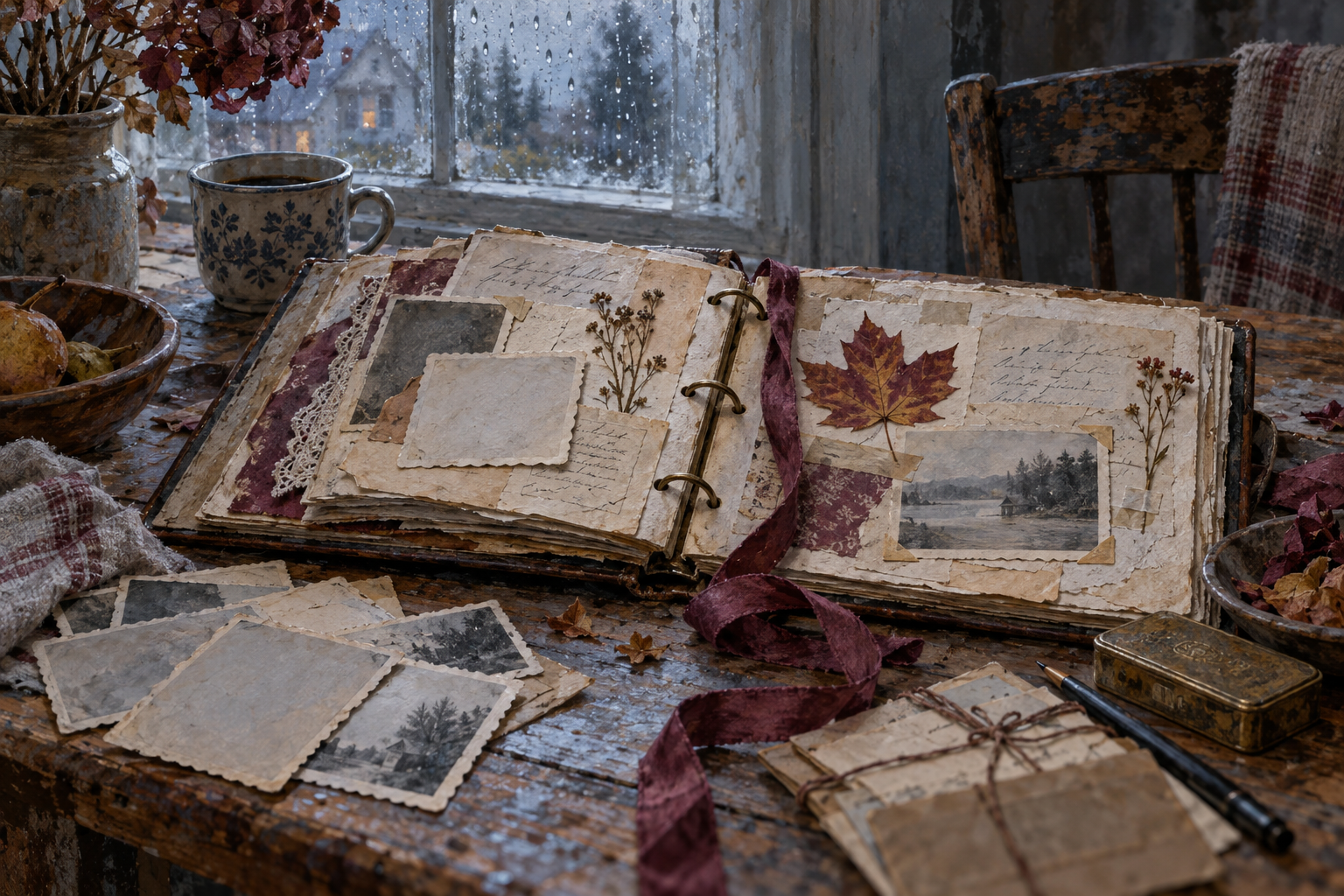
There is no single object that earns the title. It might be a bound notebook, a cheap binder, a folder of printed pages, a private digital document, or a box with notes tucked between photographs. The useful question is not whether it looks like a grimoire. The useful question is whether it can hold what you are afraid of losing.
That matters because remembrance is usually messier than biography. A formal family record wants dates, names, marriages, addresses, occupations. Those details can be precious, but they are not the whole person. Memory also lives in the sentence someone always used when they were annoyed, the exact way a kitchen smelled in November, the song that made an uncle drum on the steering wheel, the recipe no one wrote down properly, the ugly lamp everyone argued about keeping after a funeral.
A personal Book of the Dead can hold those small things without asking them to become important enough for an archive.
It can also hold uncertainty. You may know that a great-grandmother existed and almost nothing else. You may have a photograph with three unnamed people and one face that resembles yours. You may have family stories that disagree. You may have a branch of the family nobody talks about. The blank spaces are part of the record too.
That makes this kind of book useful even if your family history is incomplete, fractured, adopted, estranged, displaced, or deliberately private. You do not need a neat lineage to practice remembrance. You can document what is known, mark what is uncertain, and refuse to invent certainty just because a blank page feels uncomfortable.
Thinking about ancestral patterns fits naturally beside this idea. A family story is not only a chain of people. It is also a chain of habits, silences, skills, warnings, jokes, fears, loyalties, ways of showing love, and ways of surviving. Some of those things deserve to be carried forward. Some deserve to be set down.
The book can become a place where both are visible.
It can contain the dead you knew personally and the dead you know through other people's stories. It can contain chosen family, mentors, friends, artists, neighbors, or community elders who genuinely shaped your life. But belonging matters. Remembrance is not a scavenger hunt for interesting ancestors. Someone does not become yours because their history looks beautiful on a page.
That boundary can be quietly freeing. You do not need the most dramatic lineage. You need the relationships, influences, and inherited stories that are actually yours to hold.
A useful personal book may contain several kinds of memory at once:
- names, dates, places, and family relationships
- photographs and notes about who is pictured
- sayings, recipes, songs, gestures, habits, and household details
- copies of letters, obituaries, certificates, or handwritten scraps
- stories told by living relatives, clearly marked as remembered stories rather than proven fact
- things you inherited materially, such as tools, jewelry, books, fabric, or furniture
- things you inherited without an object, such as stubbornness, humor, fear of debt, a love of gardens, or a habit of feeding everyone before sitting down
- things you do not know yet
- things you may never know
This is where a personal myth can sit beside ordinary evidence without swallowing it. Myth, here, does not mean false. It means the meaning a story gathers as it is carried. You can keep the document and the interpretation on the same shelf while still knowing they are different things.
The book does not have to be solemn either. The dead were not solemn all the time. They had ridiculous haircuts, petty arguments, favorite snacks, terrible jokes, unfinished chores, and opinions that would make you roll your eyes. If remembrance only preserves people at funeral-volume, it can sand away the ordinary texture that made them recognizable.
A Book of the Dead can be tender enough to keep the weird bits.
Remembering Without Making the Dead Into Saints
Death can create a strange pressure to edit. A difficult person becomes 'complicated.' A cruel person becomes 'troubled.' A relative who caused real damage may be rewritten as wise because nobody wants to speak sharply near a grave.
A remembrance practice does not require that kind of polishing.
You can love someone and record the harm they caused. You can miss someone and still be angry. You can preserve a recipe without preserving the belief system of the person who taught it to you. You can feel tenderness toward a family story while also deciding that part of its inheritance stops with you.
That is one reason a personal Book of the Dead can be more useful than a memorial album. It has room for contradiction.
This does not mean turning the book into a prosecution file either. The point is not to keep every wound freshly catalogued. It is to let the record be honest enough that you are not required to split a person into saint or villain just to make the page readable.
Sometimes the most truthful sentence is simple: 'I loved them. They also hurt me.'
Sometimes it is: 'I never knew them, but their choices shaped the house I grew up in.'
Sometimes it is: 'Everyone says this story happened. I do not know whether it did.'
Sometimes it is: 'I do not want to carry this tradition forward.'
That last sentence belongs in remembrance too.
If you come from a religious background that taught a specific relationship with death, ancestors, prayer, saints, heaven, hell, or forbidden spiritual practices, building this kind of book may bring old alarms with it. You do not have to force those alarms quiet. A practice can be secular and still feel emotionally loaded because your body learned the old meanings long before you chose new ones.
Keeping mental space safe may become important if remembrance starts bumping into inherited religious fear. You are allowed to choose language that feels less charged. 'Memorial book,' 'family archive,' 'remembrance notebook,' or even 'the dead people binder' can do the same work if 'Book of the Dead' makes the whole thing feel like you have accidentally summoned a committee.
The same freedom applies to ancestor language. For some people, 'ancestor work' feels rich and connective. For others, it feels too spiritual, too genealogical, or too tangled with family relationships they do not want to romanticize. The practice does not collapse if you call it something else.
What matters is the relationship you are choosing with memory.
There is also no moral requirement to include every dead relative. Biology does not create unlimited access to your attention. If a person was abusive, frightening, or simply not someone you want centered in your inner life, their page can be brief, factual, sealed in an envelope, placed in a separate section, or absent altogether.
Absence can be a boundary rather than a failure of remembrance.
That distinction matters because ancestor work can sometimes be described as though every lineage should be welcomed, healed, honored, or reconciled. That is too tidy for real families. Some inheritances are nourishing. Some are neutral. Some are painful. Some are unknown. Some are yours to study from a distance.
A grounded practice leaves those categories open.
It also lets the living change their minds. A page written at twenty-five may not be the page you would write at forty-five. New information may arrive. A relative may tell you a story that changes the shape of another story. You may recognize that something you once called strength was actually fear wearing a useful coat. You may discover that a family villain was carrying more context than anyone gave them, or that a beloved elder was protected from accountability.
Revision is not disrespect. It is what living memory does.
A reflection journal can help keep the more personal material separate from the factual record if you want that distinction. One section can hold what happened. Another can hold what you currently think it means. Neither has to impersonate the other.
The book becomes safer when it is allowed to say, plainly, 'this is what I know,' 'this is what I was told,' and 'this is what I make of it now.'
Where Shadow Work Enters the Book
Shadow work is often dressed in dramatic language, but in a remembrance book it can be almost embarrassingly ordinary. It is the moment you notice that a family phrase still comes out of your mouth. It is realizing that everyone in three generations learned to treat rest as laziness. It is recognizing that nobody talked about money directly, so every financial problem arrived wearing shame.
The shadow is not necessarily a hidden evil self. It can be whatever a family, community, or younger version of you learned not to look at directly.
A Book of the Dead gives those patterns context.
Without context, an inherited pattern can feel strangely personal. 'Why am I like this?' becomes a closed room. Context opens a window. Maybe you are the third person in your family to keep emergency groceries because someone once lived through real scarcity. Maybe a habit that feels irrational now was once protective. Maybe the family rule against talking about feelings made sense in a dangerous household and became suffocating in a safer one.
Understanding where a pattern came from does not mean you have to keep it.
That is the useful hinge between remembrance and shadow work. The book is not asking, 'How do I honor everything I inherited?' It can ask something gentler through its structure: What is here? Where did it come from? What still belongs in my life?
You do not need to turn every memory into a lesson. Some memories are allowed to be memories. A grandmother's blue bowl does not need to symbolize the maternal line. Sometimes it is simply the bowl she used for potatoes. The practice gets thin if every object is forced to carry a thesis.
But patterns will emerge on their own when enough ordinary details are placed near each other.
You may notice how often women in the family moved for someone else's work. You may notice that several relatives changed their names, hid their language, left a church, returned to a church, married very young, never married, kept gardens, kept secrets, worked with their hands, or treated education as a door out.
Those repetitions are not destiny. They are material.
This is where introspection can be more useful than certainty. You can observe without immediately deciding what a pattern means. You can let two explanations coexist. You can note that a story feels powerful without calling that feeling evidence.
That restraint matters especially when working with relatives you never knew. It is easy to build a personality from one photograph, one census record, one family anecdote, and a strong resemblance around the eyes. The imagination will happily supply the missing rooms.
Imagination is not the enemy. It just needs a label.
If you write an imagined scene, mark it as imagined. If you make a symbolic association, call it symbolic. If you are repeating family lore, name it as family lore. That small habit lets the book be both strange and trustworthy.
It also makes room for grief that is not based on direct memory. You can grieve the grandparent you never met, the language that disappeared from the family, the home that was sold, the recipe no one remembers, the relationship that could not become safe, or the version of your family that only exists in stories.
Not every loss has a funeral.
Shadow work can also point forward. Once a pattern becomes visible, you can notice how you are already changing it. Maybe you apologize differently. Maybe you talk about money in plain language. Maybe you let children ask uncomfortable questions. Maybe you keep family recipes but stop keeping family grudges. Maybe you are the first person who can say, 'I do not know,' without treating uncertainty as failure.
That is not a grand ancestral healing claim. It is a living person making choices.
Human connection matters here because inheritance is relational. We learn ourselves partly through other people, including people who are gone. A personal Book of the Dead can make those relationships visible without pretending the dead are directing the project.
For readers who do use spiritual language, the same structure still works. You might experience an ancestor as present, symbolic, remembered, imagined, spiritually real, or some mixture that changes from day to day. The book does not have to settle the metaphysics before it can hold the relationship.
That uncertainty can be part of the practice rather than a bug in it.
One page can say, 'This is the story I inherited.' Another can say, 'This is the part I keep.' Another can say, 'This is where I choose differently.'
That is shadow work with its shoes on. Less dungeon. More family filing cabinet with emotional weather.
Making a Book You Can Actually Return To
A remembrance book can become so precious that it becomes unusable. The expensive notebook stays blank because the first page has to be worthy. The family photographs wait in a box because arranging them correctly feels like a museum job. The digital folder grows a taxonomy so elaborate that adding one memory requires six subfolders and a small administrative hearing.
That is the opposite of what the book needs.
A living archive benefits from being easy to enter badly.
Messy handwriting is still memory. A sticky note can be enough. A printed email can sit beside a handwritten recipe. A page can have only a name and a date. A photograph can be taped in crooked. You can leave three blank pages because you know more may arrive later. You can cross something out when you learn it was wrong.
The form should serve return, not ceremony.
This is especially important if your attention is nonlinear or your energy changes from day to day. A system that only works when you have a clear desk, an uninterrupted hour, archival supplies, and the soul of a Victorian records clerk will quietly become a decorative guilt object.
Low-friction counts as sacred enough.
You might keep loose categories instead of a rigid structure. 'People,' 'places,' 'objects,' 'stories,' 'patterns,' and 'unknowns' are enough for many books. Or you might organize by family branch, decade, relationship, or theme. Digital readers may prefer searchable tags. Paper readers may prefer tabs. A binder may be easier than a bound notebook because pages can move as the story changes.
There is no prize for choosing the most beautiful format.
A good structure also leaves room for different kinds of evidence. A death certificate and a remembered joke should not be treated as the same kind of source, but both belong. You can use tiny labels such as 'record,' 'family story,' 'my memory,' 'someone else's memory,' and 'interpretation.' That is often enough to keep the archive honest without turning it into academic footnotes.
Privacy matters too. Family memory is full of information that may not belong online. Living relatives can appear in stories about the dead. Old letters can contain secrets, addresses, medical details, or conflicts that are not yours to publish. A personal book can stay personal.
You can also decide what should be destroyable.
That sounds odd for an archive, but not every page needs to become an heirloom. Some pages may be for temporary anger, confusion, or processing. Some may need to be rewritten before they are passed on. Some may belong only to you. A book about the dead does not automatically become property of the future.
The idea of gentle belonging fits here. Belonging does not have to mean permanent inclusion. It can mean giving something the right-sized place.
Objects can help when words are thin. A photocopy of handwriting, a scrap of fabric, a pressed leaf from a meaningful place, a recipe card, a map, a ticket stub, or a photo of an inherited object can carry texture without requiring a long explanation. If the original is fragile or irreplaceable, use a copy and store the original safely.
Sound can be part of the archive too. A QR code or written file name can point to a voice recording, a song, an interview, or a video. Digital files are easy to lose, so keep simple backups and note what the file contains in plain language. Future-you should not have to solve 'VID_20240718_193402.mp4' like an archaeological riddle.
The book can also contain living context. A short note about who told you a story, when they told it, and what else was happening can matter later. Memory changes. Family stories change. Recording the context does not make the story less meaningful. It lets meaning and evidence sit together without wrestling for the same chair.
This is one place where everyday magic becomes a useful lens. The magic does not have to be supernatural. It can be the simple fact that an ordinary object becomes charged with attention because you know whose hands used it.
A spoon can become lineage without ceasing to be a spoon.
The same goes for ritual. You may eventually want a small practice around adding a name, opening the book on an anniversary, or reading a family recipe aloud. You may never want that. The archive is complete enough without performance.
The best sign that the book is working is not that it looks finished. It is that you can return to it.
You can add one sentence.
You can correct one date.
You can remember one thing before it disappears.
Practical Invitation
If you want to begin, treat this as a menu rather than a sequence. Pick the kind of page that feels easiest to make today and ignore the rest.
A name page can hold one person's basic details: full name, nicknames, dates if known, places connected to them, and how they fit into your life or family.
A memory page can hold one concrete scene without explaining it. The sound of a screen door. A particular coat. The cereal they always bought. The exact shape of their laugh written as badly as language requires.
An object page can preserve the story of a thing: who owned it, what it was used for, why it survived, where it is now, and what you want the next person to know.
A story page can record family lore with its source attached. 'Told by Aunt ___ in 2026' is enough. You do not have to decide whether every story is historically perfect before it deserves to be saved.
An inheritance page can gather patterns you have noticed across generations: skills, fears, phrases, jobs, migrations, silences, celebrations, ways of caring, ways of avoiding, things everyone kept, things everyone left.
An unknowns page can protect unanswered questions from being accidentally turned into facts. Unknown names, missing photographs, contradictory dates, unclear relationships, and stories you want to verify can all live there without urgency.
A boundary page can record what you are not carrying forward. It does not need to be dramatic. A sentence such as 'This tradition ends with me' can be enough.
A living thread page can show what continues in ordinary life now: a recipe still cooked, a tool still used, a song still played, a family saying that survived, a skill taught to a child, or a habit you have deliberately changed.
If even that feels like too much, use the smallest possible entry: one name, one memory, one sentence.
[ ] I am allowed to leave this unfinished.
That may be the most important line in the whole book.
You can also begin with a page about yourself. Not because you are dead, obviously, which would complicate the editorial schedule, but because you are part of the chain you are documenting. Record what you currently know, what you currently believe about the family story, and what objects or practices matter to you now. Future versions of you may read that page very differently.
If the material leaves you stirred up, switch from excavation to orientation. Drink water. Look around the room. Put the photographs away. Use gentle grounding practices if you want a soft landing. Remembrance does not become more meaningful because you push past your capacity.
You are allowed to close the book while the story is still open.
Gentle Closing
A personal Book of the Dead is not a final account of a family. It is a place where memory can stay textured: factual and uncertain, loving and angry, ordinary and strange. The point is not to solve the dead. It is to notice what their lives, absences, objects, stories, and silences still make visible in yours.
That can be enough for ancestor work. It can be enough for shadow work too. You do not need a supernatural claim, a perfect lineage, or a polished grimoire. You need a place where remembrance can be honest and where inherited meaning can be examined without being automatically obeyed.
Return when something wants to be recorded. Leave when you have had enough. Let the book grow at the speed memory actually arrives.
And when a page feels complete for now, closing gratitude can offer a gentle way to mark the moment without pretending anything has been permanently resolved. The dead remain complicated. The living remain unfinished. The book can hold both.