18 minute read
Creative Re-Entry After a Season of Outside Stress
Opening Reflection
Creative re-entry after outside stress can feel less like inspiration and more like standing in a doorway with your hand still on the frame. This story is about guiding yourself back to your own projects after your energy has been spent on survival, caregiving, worry, logistics, or whatever loud weather pulled your focus away. It lives in the world of gentle productivity, personal projects, and the soft awkwardness of beginning again.
If that threshold feels familiar, you might also want to keep Creative Re-Entry Ritual for Personal Projects, Returning to Quiet Projects with Gentle Hands, and Consent To Continue nearby like small lanterns rather than instructions.
The Season of Outside Things
It had not been one dramatic catastrophe. That would have been easier to narrate.
It had been weeks, maybe months, of being turned outward.
A thousand small demands with real teeth. Messages that needed answering. Plans that kept changing. Worry that did not announce itself as worry, but moved into the body like weather settling in old wood. The kind of stretch where your mind becomes a hallway other people keep walking through. Nothing in that season felt fake. None of it was laziness. None of it was a failure of devotion. Life had simply become very loud, and the loudness had needed tending.
The project waited in the background with the patient hurt look of a game save file you love but have not opened in too long. Not accusing. Just there.
Sometimes the person would think about it while doing something unrelated. Folding laundry. Waiting for water to boil. Looking for a receipt. A line would drift through. An image. A feature. A title idea. A shape for a paragraph. And for one second there was that old hum again, that private signal that said: there you are.
Then the second thought would arrive. Too late now. You are out of rhythm. You forgot too much. It will take too much to get back in. Better to return properly when there is time, when you are clearheaded, when the room is clean, when you are less frayed, when you can do it justice.
The trouble with this kind of thinking is that it wears the costume of respect. It sounds noble. It sounds like you are waiting to treat your project with proper care. But often it is just fear in a nicer cardigan.
The person knew this, vaguely. Knew it in the same way you know a plant needs light while still forgetting to turn the pot.
So the project stayed untouched. Not unloved. Untouched.
That distinction mattered.
Because there is a difference between not caring and being overrun.
Outside stress has a way of changing the scale of everything. Your own work begins to look both too small and too huge. Too small compared to the urgent things that kept pulling you away. Too huge because re-entering means meeting yourself again, and maybe noticing where the thread snapped.
On some days the person called this Brain Fog. On other days it felt closer to Rest And Survival, where even the smallest personal choice had to queue politely behind basic functioning. Occasionally it turned into that stale ache described in When Everything Feels Pointless, where meaning itself seemed to dim for a while, not permanently, just long enough to make everything feel like cardboard.
Still, underneath all that, the project had not gone dead. It had gone quiet.
And quiet is not the same as gone.
That became the first useful thought. Not a triumphant thought. Not a sparkling revelation. Just a modest one. The kind you could tuck into a pocket.
Quiet is not gone.
The person repeated it while wiping the kitchen counter. While closing tabs. While moving a sock from the table to the laundry basket. Quiet is not gone.
It did not fix anything. But it loosened something.
Enough, at least, to make looking possible.
The Room Still Waiting
The project lived at a desk by a window. Or in a notebook on a shelf. Or in a folder on a laptop whose desktop had become a graveyard of screenshots and temporary files. The exact form changed, but the feeling was the same: there was a place where the work had once been welcome, and it had been a while since anyone visited.
The person did not sit down right away.
First they hovered.
Hovering is its own ritual, though nobody likes to admit it. Straightening one corner of the desk. Moving a mug that no longer belongs there. Touching the notebook but not opening it. Waking the laptop. Checking the time. Looking away. Looking back.
The room seemed to understand the awkwardness.
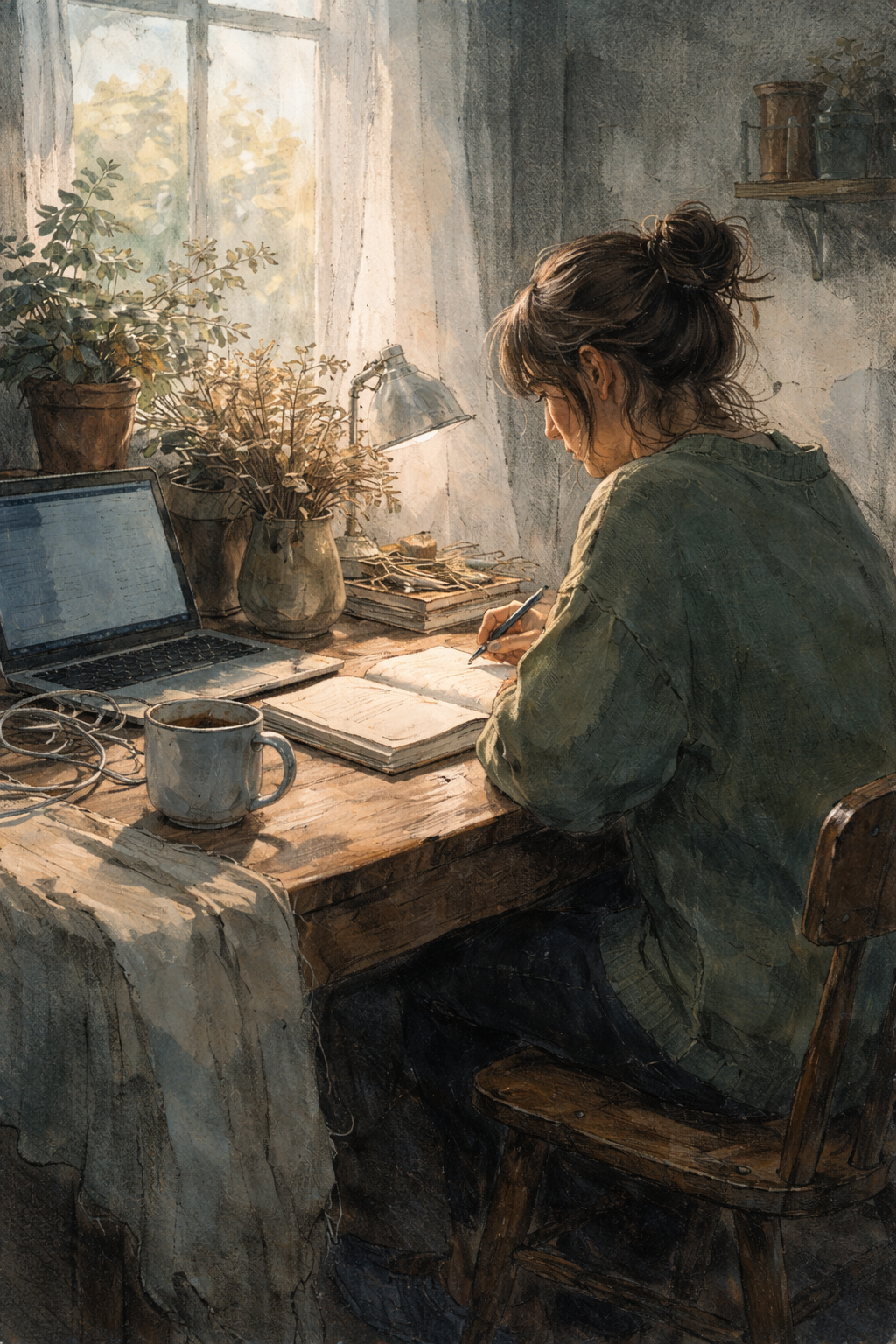
Morning light was coming in sideways, cool and pale, the kind that makes dust look almost holy. The desk had the soft evidence of an interrupted life: a pen with the cap missing, a coaster stained into a faint ring, a charging cable looping over itself like a sleeping snake, the rough weave of an old cloth under one stack of paper. Nothing cinematic. Nothing transformed into a perfect artist's nook while the person was away. It still looked like a real place used by a real person. That helped.
A big dramatic return would have felt false in that room.
No incense. No fresh start playlist. No pledge to become deeply disciplined as of this exact Tuesday.
Just a chair. A surface. A body.
The person sat.
For a few seconds, that was the whole event.
And even that felt tender.
There is a strange ache in sitting down with something you loved before stress rearranged your attention. It is a little like meeting an old version of yourself in a grocery store aisle. You recognize them immediately, but you also notice the gap. What they cared about. What they thought was possible. What they were building before life asked them to carry twelve other bags at once.
The first impulse was to apologize to the project.
The second was to shut the laptop again.
Instead, the person opened the document.
Not to work yet. Just to look.
This turned out to matter more than expected.
Because the fantasy of the abandoned project had become worse than the reality. In imagination it was a sprawling, incoherent thing. Embarrassing. Overcomplicated. Full of evidence that the person had once believed they could hold a bigger shape than they now could. But on screen it was simpler. Messy, yes. Incomplete, yes. But not monstrous.
There were sentences that still held. Notes that were surprisingly useful. Fragments that made the person smile in spite of themselves. One ridiculous line that said something like fix this ugly goblin section later, and that tiny flash of old humor did more good than any formal productivity advice might have.
The project had not frozen in sacred perfection while waiting. It had remained human.
That made re-entry feel less like facing judgment and more like rejoining a conversation paused mid-sentence.
The person clicked around slowly. Opened the notes file. Closed three irrelevant tabs. Found the sketch. Found the list. Found the half-plan underneath the newer pile of obligations. Somewhere in the process, the room began to feel less like a museum and more like a camp being set back up after weather.
They thought of Quiet Progress then. Of the idea that progress does not have to announce itself with trumpets or color-coded dashboards. Sometimes it is just the moment a thing becomes reachable again.
Outside, a car passed. The fridge made its ordinary humming sound. A neighbor's door thudded shut in the hallway. None of it was magical. And because none of it was magical, it was easier to believe the return could be real.
There is a kind of relief in not needing the atmosphere to do all the work.
The person had spent enough time being pulled by urgent things. They did not need their creative life to become another performance of urgency.
They needed a room that would let them arrive in wrinkled clothes, carrying all the static they had not yet shaken off.
This room, imperfectly, did.
Before doing anything else, they opened a blank note and typed a sentence they did not overthink: I am not starting from zero. I am starting from interruption.
That sentence sat there with a steadiness that surprised them.
Not starting from zero.
Starting from interruption.
That felt evidence-friendly. Secular. Almost practical.
It also felt kind.
And kindness, here, was not softness in the flimsy sense. It was structural. It kept the whole bridge from collapsing under the weight of shame.
The person breathed out.
For the first time in a while, the project no longer looked like a test.
It looked like somewhere to place some of the self that had been on hold.
The First Small Touch
The person knew better than to make a five-year plan on the first day back.
This was not the day for visionary overhaul. Not the day to rename every folder, redesign the workflow, draft the manifesto, create a content calendar, rebuild the app, or decide the entire future of the work.
Those urges were familiar. They often arrived when direct contact felt scary. A cloud of very intelligent side quests. A swarm of adjacent tasks pretending to be momentum.
So the person made a quieter choice.
They touched one thing.
Not everything. One thing.
In one version of this story, it was rewriting the first paragraph of a post. In another, it was opening the code file and changing a label that had bothered them for months. In another, it was moving a scattered list into a cleaner document so the project stopped feeling like a dropped stack of papers in the wind. The exact action mattered less than its size.
It needed to be small enough that the nervous system would not interpret it as another demand to survive.
So they picked the task with the least emotional drag and the clearest shape.
They edited a sentence.
Then another.
The room did not erupt into cinematic meaning. No choir. No full-body certainty. No immediate sense that the entire creative identity had returned from the dead wearing a glitter cape.
Just a small click.
A texture of rightness.
Like fitting the first puzzle piece into a corner and realizing the board is still there.
That was enough to keep going a little longer.
The next thing the person did was leave a breadcrumb. Not because they were suddenly transformed into the patron saint of systems, but because they knew this version of themselves might be tired again tomorrow. They wrote a note in plain language: next, clean up the section headings and decide what still belongs.
No poetry. No optimization jargon. Just a path.
Then they stepped away for tea.
This part mattered too.
Because creative re-entry after outside stress is not only about making contact with the work. It is also about proving to yourself that contact will not trap you. You are allowed to touch the project and then leave. Allowed to return without pledging your whole body to it. Allowed to build trust in increments.
While the kettle warmed, the person leaned against the counter and noticed an unfamiliar feeling.
Not excitement exactly.
Relief.
The project was no longer an unopened letter on the table.
It had become a living thing again, even if only in a very small way.
The tea steamed up the window a little. The spoon knocked once against the mug. Somewhere between the kettle and the first sip, the person realized that part of the exhaustion had come not only from outside stress itself, but from dragging the weight of postponed return around every day. Avoidance is heavy in a sneaky way. It charges rent.
That did not mean the person launched into shame. It just meant the cost became visible.
They thought, with a kind of crooked affection, of Pauses, and of how not every pause is the same. Some are nourishing. Some are protective. Some quietly sour because they were never meant to last that long. Knowing the difference is part of growing around your own patterns instead of fighting them like a cartoon enemy.
Back at the desk, they read over the little changes and found them decent.
Not brilliant. Decent.
Decent is underrated.
Decent is how many real things get made.
The person remembered reading about narrative identity, the idea that people make meaning by organizing their lives into story. It helped explain why returning to a project after stress can feel so emotionally charged. You are not only revisiting a file. You are revisiting the story you told yourself about who you were when you started, who you became while life got loud, and who you might be now.
Seen that way, the awkwardness made sense.
It was not proof of failure.
It was proof that the work had been carrying part of the self.
The person stayed another twenty minutes.
Not because they forced it.
Because the threshold had already been crossed, and once crossed, the room felt less hostile.
They reorganized two notes. Deleted one outdated section. Highlighted a sentence that still glowed. Wrote a quick question into the margin: what does this project actually want to be now?
That question would matter later.
For now, the important thing was simpler.
The hand had touched the thread.
And the thread had not broken.
Letting the Project Become Honest Again
The next day was not perfect.
This may be the most useful part of the whole story.
The person did not wake up as a radiant productivity woodland creature, suddenly devoted to two-hour deep work blocks and color-coded folders. They were still themselves. Still interrupted. Still carrying some static from the outside world. Still vulnerable to distraction, dread, fatigue, and the bizarre gravitational pull of little tasks that multiply when you are trying to do something meaningful.
But the project was no longer sealed off behind ceremony.
That changed the scale.
Instead of asking, can I fully return and become the person I was before, the person started asking smaller and truer questions.
Can I sit with it for fifteen minutes?
Can I make one honest decision?
Can I notice what no longer fits?
Can I stop trying to revive the fantasy version of this project and meet the one that actually exists?
That last question opened the deepest door.
Because sometimes creative re-entry is not really blocked by outside stress anymore. Sometimes it is blocked by loyalty to an outdated internal script.
The person had been trying, without realizing it, to return to a version of the project shaped by an older season. A season before the stress. Before the rearrangement. Before certain truths had come into focus. No wonder the return felt off. They were aiming for a room that no longer existed.
So they let the project become honest again.
This did not mean throwing everything out. It meant letting certain plans loosen their grip.
A section that had once felt essential now felt performative. Gone.
A more complicated feature that once seemed impressive now felt like carrying a wardrobe up a staircase for no reason. Deferred.
A quieter thread, one that had been buried under bolder ideas, now seemed to hold the real pulse. Kept.
Creative work often becomes more itself after pressure strips away decorative ambition.
Not smaller in a sad way.
Cleaner.
More faithful.
The person was surprised to discover that outside stress had not only taken from the project. It had also clarified something. After too much time spent attending to things that truly mattered in ordinary human ways, some forms of artistic posturing became harder to tolerate. There was less appetite for fluff. Less patience for ornate self-distortion. Less desire to make something that only looked alive from a distance.
They wanted work that could breathe.
Work that could be returned to by a tired person, not only an ideal one.
That realization connected, unexpectedly, with Staying Exactly Yourself. Not in a rigid identity sense. More in the sense of allowing the work to stop cosplaying as who you think you should be. A personal project can drift away from you when it becomes too entangled with performance, too loaded with redemption, too eager to prove that you are disciplined, gifted, wise, serious, healed, or somehow finally legitimate.
Sometimes the kindest creative re-entry is not dramatic motivation. It is taking off the costume.
The person began trimming with that in mind.
Not from disgust. From fidelity.
They kept asking: does this feel alive now?
A simple question. Quiet. Usable.
It worked better than trying to predict whether anyone else would be impressed.
As the project changed, the person changed with it. Or maybe changed back toward themselves. Hard to say. Either way, the work stopped feeling like a shrine to a lost season and started feeling like a table they could actually use.
There were still hard moments. Still odd bursts of resistance. Still mornings when outside stress barged in early and ate the best part of the day. Still afternoons when the person opened the document, stared, and closed it again.
But even those moments had changed texture.
They no longer meant the doorway was gone.
They just meant the doorway would need to be used again.
That is a quieter truth than the internet usually offers. Not a fix. Not a hack. Not a 5-step transformation from scattered to unstoppable.
More like brushing the path a little each time you walk it.
The person began leaving themselves gentle infrastructure. A note at the top of the document. A short list of live threads. A file named start-here-again. A clean surface on the desk before bed if they had the capacity. Not because they had become a lifestyle content version of themselves, but because re-entry deserves support.
This support was especially important on low-energy days. Days when the mind felt porous and the body moved like wet wool. On those days, the person borrowed from Smallest Acts, Gentle Self Care Practices, and even What to Do With Free Time Instead of Doomscrolling, not because the project was a wellness routine, but because attention is physical. Returning to your work is easier when your senses are not being chewed on by every open loop in the room.
Some sessions lasted ten minutes. Some lasted an hour. Some turned out to be mostly sorting, mostly noticing, mostly sitting near the work until the work stopped flinching.
All of it counted.
That became another structural kindness.
All of it counted.
Not equally. Not in the same category. But counted.
A page of writing counted.
So did opening the folder and identifying the next real step.
So did admitting that a section was dead weight.
So did noticing that the project wanted a different tone now.
So did deciding not to push when the body was clearly done.
This kind of accounting is less glamorous than the usual before-and-after arc. But it is far more compatible with a real life, especially one that has recently been occupied by stress from outside the work.
The person was not returning to a private kingdom untouched by the world.
They were building a bridge between the world and the self again.
Slowly.
By hand.
And because it was by hand, the bridge held.
Gentle Takeaway
Maybe this is the part worth carrying forward: creative re-entry is not a referendum on whether you still have it. It is a practice of making the work reachable again.
After outside stress, your own projects can feel shy. Or distant. Or weirdly charged. That does not mean the relationship is broken. It usually means too much life happened at the threshold, and now the threshold needs to be softened.
You do not need to storm back in.
You can come back the way many real things come back: by sitting down, touching one piece, leaving a breadcrumb, and letting the work become honest enough to meet you where you actually are.
If your nervous system wants permission before momentum, keep Quiet Permission and Gentle Rituals within reach. Not as rules. As reminders that there are ways to return without violence.
Closing Reflection
There is a special kind of grief in realizing how long your attention has belonged to things outside yourself. There is also a special kind of relief in noticing that your own work is still here, a little dusty maybe, a little changed, but still willing to recognize your footsteps.
This story is not about mastering creativity. It is about creative re-entry after outside stress: the slow, human work of turning back toward your own projects without pretending the hard season did not happen. The point is not to erase interruption. The point is to build from it.
Return in a wrinkled mood. Return with half a plan. Return with tea, with a note, with one edited sentence, with ten shaky minutes. Return without fanfare if that is what is available. There is no prize for making the doorway harder than it already is.
And if you need one more soft companion for the road, Returning to Quiet Projects with Gentle Hands is waiting just a few steps over, like a light left on in the next room.